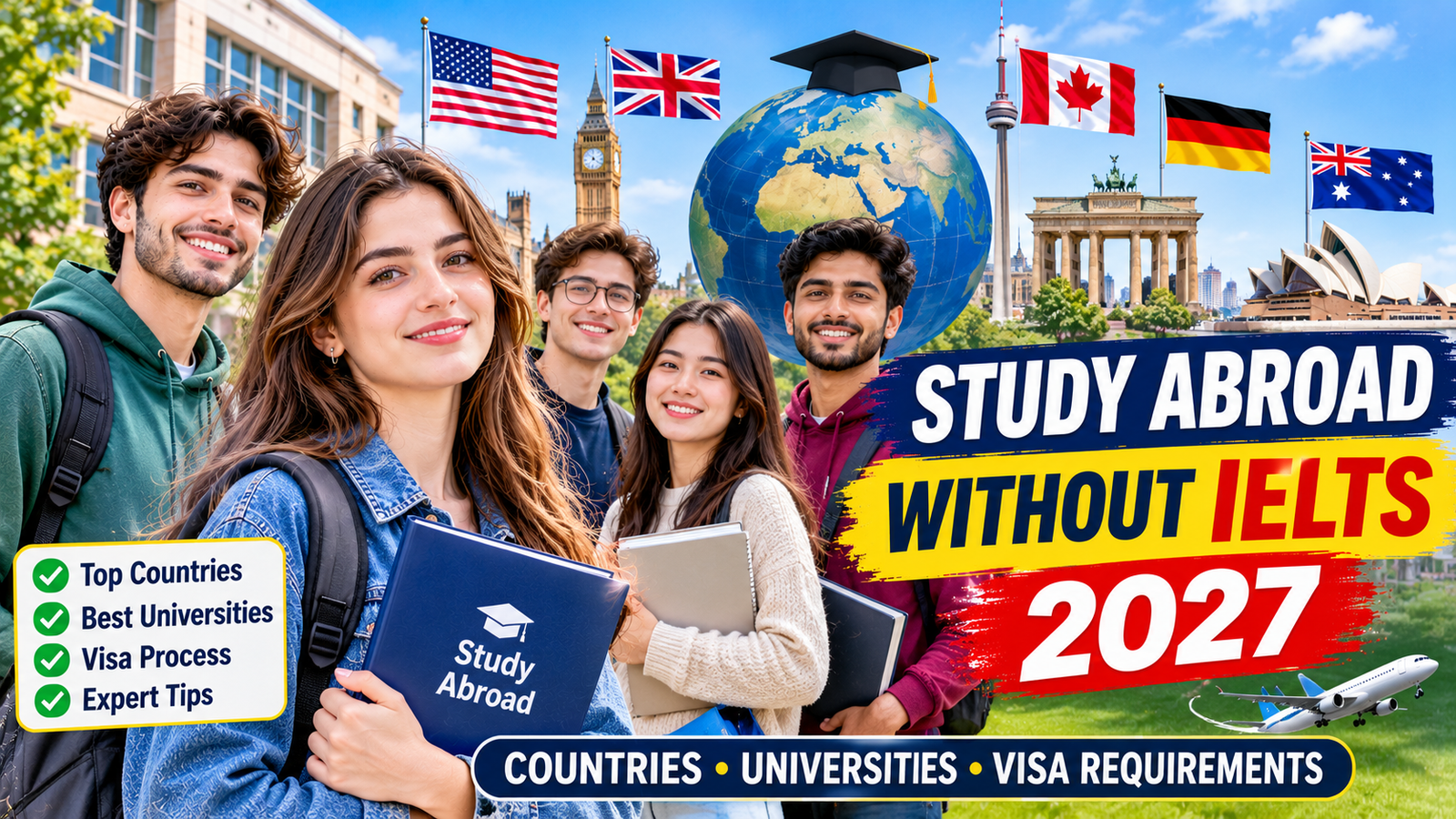
Studying abroad is a dream for many international students, but the cost and preparation required for the IELTS examination can become a major obstacle. The good news is that IELTS is not the only way to demonstrate English-language proficiency. Several universities around the world accept alternative English tests, Medium of Instruction (MOI) certificates, previous English-medium education, university interviews, or internal language assessments.
For 2027, students may find opportunities to study in countries such as the United States, Canada, the United Kingdom, Germany, Malaysia, Hungary, and other European destinations without submitting an IELTS score. However, the exact requirements depend on the university, degree programme, and immigration rules.
One important point must be understood: getting admission without IELTS does not automatically mean receiving a student visa without English-language evidence. Universities and immigration authorities may have different requirements.
This guide explains the countries where IELTS alternatives may be accepted, universities to research, possible visa requirements, and how international students can prepare a successful application for 2027.
Can You Study Abroad Without IELTS in 2027?
Yes. International students can apply to selected universities without IELTS in 2027, provided they meet the institution’s alternative English-language requirements.
Some universities accept an English-medium education certificate, while others require TOEFL, PTE Academic, Duolingo English Test, Cambridge English qualifications, or an internal assessment.
For example, a student who completed a previous degree entirely in English may qualify for an English-test waiver at certain universities. Other institutions may conduct an online interview to assess the applicant’s communication skills.
However, there is no worldwide policy that automatically exempts international students from IELTS.
Before applying, check three separate requirements:
- University admission: Does the university accept an alternative to IELTS?
- Programme admission: Does your particular degree have additional English-language requirements?
- Student visa: Does the destination country’s immigration authority require a recognised test or accept the university’s assessment?
Understanding these differences can prevent application delays and unexpected expenses.
Best Countries to Study Abroad Without IELTS in 2027
The following destinations offer different opportunities for students who want to avoid IELTS. The availability of an exemption depends on the institution, programme, and applicant’s educational background.
1. United States
The United States is an attractive destination for international students because universities establish their own admission policies and may accept several English-language assessments.
Many American institutions accept TOEFL iBT, Duolingo English Test, PTE Academic, or Cambridge qualifications instead of IELTS. Some universities also provide exemptions to applicants who completed an eligible degree or a specified period of education in English.
Universities to research:
- Arizona State University
- Brandeis University
- Purdue University
- University of Arizona
- University of Wisconsin–Madison
These institutions have published English-language policies that include alternatives or specific exemption conditions. For example, Brandeis University lists circumstances in which eligible graduate applicants can apply without an English-language test score. Arizona State University also provides certain exemption and conditional-admission routes.
Student visa requirements:
The US F-1 student visa process does not establish IELTS as a universal, separate visa requirement. However, students must first satisfy their university’s admission requirements and receive the necessary Form I-20.
Applicants should prepare for a visa interview and be able to explain their study plans, financial arrangements, and academic background.
2. Canada
Canada is another popular destination for international students. Canadian universities and colleges establish their own English-language admission requirements.
Some institutions may accept alternatives such as:
- TOEFL iBT
- PTE Academic
- Duolingo English Test
- CAEL
- Cambridge English qualifications
- Eligible previous English-medium education
Some institutions may also provide pathway or English-language preparation programmes.
Universities to research:
- University of Toronto
- University of British Columbia
- York University
- University of Saskatchewan
- University of Waterloo
Do not assume that these universities automatically waive IELTS for Pakistani applicants. Their English-language policies vary by programme and previous education. Some require a recognised test even when an applicant has an MOI certificate.
Student visa requirements:
Canada’s regular study permit eligibility requirements focus on matters such as admission to a Designated Learning Institution (DLI), financial resources, and other immigration conditions. A universal IELTS score is not listed as a general requirement in the standard study permit eligibility criteria.
However, the institution can still require proof of English before issuing admission. Visa officers may also request additional documents depending on the applicant’s circumstances.
Students should also check whether their chosen programme and institution are eligible for a Post-Graduation Work Permit (PGWP), because separate language requirements can apply to graduates.
3. United Kingdom
The United Kingdom offers several possible routes for students who do not have IELTS.
For degree-level courses, certain higher education institutions can assess an applicant’s English-language ability themselves. Depending on the institution, students may be asked to complete an internal English assessment, interview, or another accepted test.
Some universities also consider previous education completed in English.
Universities to research:
- University of Greenwich
- Birmingham City University
- University of Portsmouth
- University of Hertfordshire
- University of Bolton
These are institutions worth investigating for their current English-language admission policies. Acceptance of an alternative or waiver must be confirmed for the exact course and intake.
Student visa requirements:
UK Student visa applicants generally need to demonstrate English at the required level.
For degree-level study, the required standard is normally CEFR B2. For courses below degree level, the standard is normally CEFR B1.
Depending on the applicant and course, English can be demonstrated through an approved Secure English Language Test (SELT), an eligible degree taught in English assessed through Ecctis, or an assessment conducted by an authorised higher education provider.
An MOI letter alone should not be assumed to satisfy the visa requirement.
4. Germany
Germany is an excellent destination to investigate, particularly for students interested in engineering, technology, business, and postgraduate education.
Many German universities offer English-taught master’s programmes. Some programmes accept alternatives to IELTS, including TOEFL, Cambridge qualifications, or other recognised evidence of English proficiency.
Certain universities and programmes may consider previous English-medium education, but this is not a universal rule.
Universities to research:
- University of Bonn
- Karlsruhe Institute of Technology
- Free University of Berlin
- RWTH Aachen University
- Technical University of Darmstadt
Always check the specific programme’s admission page. A university may accept an MOI certificate for one master’s programme but require a formal test for another.
Students applying to German-taught programmes generally need to demonstrate German-language proficiency rather than English proficiency.
Student visa requirements:
German student visa applicants normally need university admission and must meet the relevant financial, insurance, and documentation requirements. Language evidence may depend on the programme and the university’s admission decision.
Do not assume that a university’s IELTS waiver automatically settles every visa-document requirement. Check the instructions of the German mission responsible for your country.
Malaysia is worth considering for students looking for comparatively accessible international education options.
Some Malaysian universities may accept previous English-medium education, an MOI certificate, alternative English tests, or an internal assessment, depending on the programme.
Universities to research:
- University of Malaya
- Universiti Putra Malaysia
- Universiti Teknologi Malaysia
- Taylor’s University
- Asia Pacific University of Technology & Innovation
International students should check the English-language requirements for their exact degree and intake. Requirements can differ between public universities, private universities, and individual faculties.
Student visa requirements:
International students generally need admission to an eligible institution and must follow the student-pass process managed through the relevant Malaysian authorities.
An IELTS exemption at university level does not necessarily remove every English-language condition. Confirm the institution’s requirements before paying application or processing fees.
6. Hungary
Hungary is another European destination that students can investigate for English-taught bachelor’s and master’s programmes.
Some institutions may assess English through an online interview, an entrance examination, or alternative language qualifications. Applicants with previous English-medium education should ask whether an MOI certificate can be considered.
Universities to research:
- University of Debrecen
- University of Pécs
- University of Szeged
- Eötvös Loránd University
- Budapest University of Technology and Economics
Do not treat these universities as guaranteed IELTS-free options. Each institution and programme publishes its own admission requirements, and some departments require formal English test scores.
Student visa requirements:
Students generally need an admission letter, proof of financial resources, accommodation arrangements, health insurance, and other documents required by the Hungarian immigration authorities.
Applicants should check whether the university’s English assessment is sufficient for their programme and whether additional evidence is requested during the visa process.
7. Italy
Italy offers international students a range of English-taught programmes, particularly at postgraduate level.
Some institutions may accept alternative English-language qualifications or consider previous education conducted in English. Others require IELTS, TOEFL, or another recognised certificate.
Universities to research:
- University of Bologna
- University of Padua
- University of Pisa
- Sapienza University of Rome
- Politecnico di Milano
Admission requirements vary significantly between courses. Some programmes may also conduct interviews or entrance assessments.
Student visa requirements:
Students generally need university admission or the required pre-enrolment documentation, proof of financial resources, accommodation information, and the other documents specified by the Italian embassy or consulate.
Check the language requirements for both admission and visa documentation before submitting an application.
Best IELTS Alternatives Accepted by Universities
If you do not have IELTS, you may still be able to demonstrate your English-language ability through another method.
Here are some of the most common alternatives.
1. Medium of Instruction (MOI) Certificate
A Medium of Instruction certificate is an official document issued by your previous educational institution. It confirms the language used to teach your academic programme.
For example, if you completed your bachelor’s degree in an institution where all subjects were taught in English, you can ask the university to issue an MOI certificate.
The document should normally include:
- Your full name
- Degree or programme title
- Duration of study
- Confirmation that English was the language of instruction
- Official university stamp or signature
- Contact information of the issuing institution
An MOI certificate is not accepted everywhere. Some universities require additional evidence or a formal language test.
2. Duolingo English Test
The Duolingo English Test is an online English-language assessment accepted by many universities.
Students can take it remotely, and results are generally available faster than traditional examination routes.
However, acceptance varies. Some universities accept Duolingo for undergraduate admission but not for postgraduate courses, scholarships, or specific departments.
Also, a university accepting Duolingo does not mean the destination country’s immigration authority accepts it for visa purposes.
3. TOEFL iBT
TOEFL iBT is a widely recognised alternative to IELTS.
It assesses reading, listening, speaking, and writing skills. Many universities in the United States, Canada, Europe, and other destinations list TOEFL among their accepted qualifications.
Applicants should check the latest score scale and the minimum requirements published by their university.
4. PTE Academic
PTE Academic is another popular English-language test.
Some universities accept PTE Academic instead of IELTS for undergraduate and postgraduate admissions. It may be useful for students applying to institutions in Australia, the United Kingdom, Canada, and other countries.
However, always check whether the institution and immigration authority accept the particular PTE test format you plan to take.
5. University English Interview
Some universities conduct an online interview to assess an applicant’s speaking and communication skills.
The interviewer may ask questions about:
- Your academic background
- Why you selected the university
- Your chosen degree programme
- Your future career plans
- Your ability to communicate in English
An interview-based exemption is available only where the university or programme officially offers it.
6. University’s Internal English Test
Some institutions organise their own English-language assessment.
If you meet the required standard, the university may allow you to proceed without IELTS or another external test.
Ask the admissions office whether the internal test is accepted for your exact course and whether it satisfies any relevant visa requirements.
Universities That Offer English Test Waivers: Examples to Investigate
The following examples can help applicants begin their research. They are not a guarantee of admission without IELTS, and the conditions must be checked directly with each institution.
| University | Country | Possible route to investigate |
|---|---|---|
| Brandeis University | USA | Specific graduate English-test waiver conditions |
| Arizona State University | USA | Eligible English-medium education exemptions and conditional admission |
| Purdue University | USA | Accepted alternative tests and specific exemption conditions |
| University of Toronto | Canada | Alternative English tests and programme-specific exemptions |
| University of British Columbia | Canada | Alternative English tests and published exemption conditions |
| University of Bonn | Germany | Programme-specific English-language evidence |
| University of Debrecen | Hungary | Programme-specific English assessment |
| University of Malaya | Malaysia | Programme-specific English requirements |
Always use the official admissions website. A general claim that a university accepts students without IELTS is not enough to establish that your chosen course will accept your application.
Student Visa Requirements Without IELTS in 2027
One of the biggest mistakes international students make is confusing university admission with visa approval.
A university may accept an applicant without IELTS, but immigration authorities can still require evidence of English proficiency or other documents.
Here is a general overview of what applicants should check.
United States
For an F-1 visa, students generally need:
- Admission to an authorised US institution
- Form I-20
- Valid passport
- Evidence of financial support
- Payment of the required visa-related fees
- Completion of the visa application
- Attendance at the visa interview, when required
There is no universal IELTS score set as a separate F-1 visa requirement. However, the university’s admission requirements still matter.
Canada
Students generally need:
- Letter of acceptance from a Designated Learning Institution
- Provincial or territorial attestation letter, when required
- Proof of sufficient financial resources
- Valid passport and identity documents
- Supporting documents requested by the visa office
- Medical examination or police certificate, if applicable
The institution may still require English-language evidence before admission.
United Kingdom
Students generally need:
- Confirmation of Acceptance for Studies (CAS)
- Evidence of English-language ability at the required level
- Financial evidence, where required
- Valid passport
- Tuberculosis test, if applicable
- Other documents specified by UK immigration rules
An eligible university assessment or degree taught in English may be accepted under the relevant rules.
Germany
Students generally need:
- University admission letter
- Proof of financial resources
- Health insurance
- Valid passport
- Academic documents
- Visa application forms and supporting evidence
- Language evidence, where required
Requirements can differ depending on the university, programme, and German mission.
Australia
Australia requires particular attention because its student visa has specific English-language evidence rules.
Applicants may need an approved English test unless they qualify for an exemption. Accepted tests and minimum scores are specified by the Department of Home Affairs, and the accepted test list can change.
PTE Academic, TOEFL iBT, and IELTS are among the listed options, subject to the applicable test conditions and score requirements.
Therefore, Australia should not be treated as a generally IELTS-free destination for every Pakistani applicant.
How Pakistani Students Can Apply Without IELTS
Pakistani students planning to study abroad in 2027 should follow a careful application strategy.
Step 1: Select Your Destination
First, decide which country is suitable for your education, budget, and career goals.
For example:
- USA: Consider universities with English-test waivers or alternative tests.
- Canada: Research institutions accepting alternatives to IELTS.
- UK: Check whether your university can assess English at degree level.
- Germany: Search for English-taught programmes with suitable language alternatives.
- Malaysia: Investigate universities that consider English-medium education.
- Hungary: Check whether the programme offers an interview or internal assessment.
Step 2: Choose Your Degree Programme
Select a programme that matches your previous education and academic qualifications.
Check the following details:
- Academic entry requirements
- Minimum grades
- English-language requirements
- Tuition fees
- Scholarship availability
- Application deadlines
- Programme duration
Do not select a university only because an agent claims it offers admission without IELTS.
Step 3: Request an MOI Certificate
If you studied in English, contact your previous school, college, or university.
Ask for an official Medium of Instruction certificate that confirms the language used during your education.
Make sure the information is accurate and matches your academic documents.
Step 4: Contact the University
Before submitting your application, email the admissions office and ask whether your MOI certificate or another English-language qualification can replace IELTS.
Ask the university to confirm its policy in writing.
Step 5: Prepare Your Academic Documents
Most international applications require some combination of:
- Valid passport
- Academic transcripts
- Degree or school certificates
- Statement of Purpose (SOP)
- Recommendation letters
- CV or résumé, where required
- MOI certificate or accepted English test result
- Portfolio or research proposal, where applicable
The exact document list depends on the degree and institution.
Step 6: Apply for Scholarships
Students who want to reduce their education costs should search for university scholarships, government-funded awards, and international scholarship programmes.
Some scholarships cover full tuition, while others provide partial tuition support or living allowances.
Always check whether the scholarship has separate English-language requirements. A university admission waiver does not automatically waive the scholarship’s language conditions.
Step 7: Apply for Your Student Visa
After receiving an admission offer and completing the university’s enrolment process, follow the official visa instructions for your destination.
Submit genuine documents and make sure that your financial evidence, academic history, and study plans are consistent.
Never rely on an agent’s verbal promise that a visa is guaranteed without IELTS.
Documents Required to Study Abroad Without IELTS
Although requirements differ between countries, the following documents are commonly requested during international university applications.
| Document | Purpose |
|---|---|
| Passport | Confirms identity and nationality |
| Academic transcripts | Shows previous academic performance |
| Degree certificates | Confirms completed qualifications |
| MOI certificate | Provides evidence of English-medium education |
| Statement of Purpose | Explains academic goals and reasons for applying |
| Recommendation letters | Supports the applicant’s academic profile |
| CV or résumé | Summarises education and experience |
| Financial documents | Demonstrates ability to cover study and living expenses |
| Admission letter | Confirms acceptance by the institution |
Some programmes may require additional documents, such as research proposals, portfolios, work experience letters, or entrance examination results.
Common Mistakes to Avoid When Applying Without IELTS
Students should be careful when selecting universities and immigration routes.
Avoid these common mistakes:
1. Believing every university accepts MOI
An MOI certificate is not universally accepted. Always check the exact programme’s policy.
2. Assuming admission guarantees a visa
A university offer letter does not guarantee a student visa. Immigration authorities make their own decisions.
3. Paying an agent without verification
Before paying an application or consultancy fee, confirm the university and programme through official websites.
4. Ignoring scholarship conditions
Scholarship providers may have separate English-language requirements even if the university offers an IELTS waiver.
5. Using false documents
Never submit a fake MOI certificate, academic transcript, bank statement, or English-language result. False information can lead to rejection and serious immigration consequences.
6. Applying too late
Some programmes have limited places and early deadlines. Begin preparing your documents several months before your preferred 2027 intake.
Frequently Asked Questions
1. Can I study abroad in 2027 without IELTS?
Yes. Some universities accept alternatives such as TOEFL, PTE Academic, Duolingo English Test, MOI certificates, internal assessments, or interviews. Eligibility depends on the university and programme.
2. Which country is easiest for studying without IELTS?
There is no single easiest country for every student. The USA, Canada, Malaysia, Germany, and Hungary are worth researching because selected institutions may accept alternatives or offer exemptions. Visa requirements must still be checked separately.
3. Can Pakistani students study in the USA without IELTS?
Yes, eligible Pakistani students can apply to US universities that accept alternative English tests or provide an English-language waiver. Each university sets its own conditions.
4. Is an MOI certificate enough for admission?
It can be sufficient at certain universities and for selected programmes. Other institutions may require an additional English test, interview, or assessment.
5. Can I get a UK student visa without IELTS?
In some cases, yes. For degree-level courses, an eligible higher education provider may assess English itself. Other accepted routes include an eligible degree taught in English assessed through Ecctis or an approved SELT.
6. Is IELTS compulsory for a Canadian study permit?
IRCC’s general study permit eligibility criteria do not establish one universal IELTS score for all applicants. However, your university or college may require English-language evidence for admission.
7. Can I get a scholarship without IELTS?
Some scholarship programmes accept alternative English-language qualifications or follow the university’s exemption policy. Others require a specific test score. Always review the scholarship’s separate eligibility rules.
8. Does Australia allow students to apply without IELTS?
Some applicants may qualify for an English-language test exemption, while others can use an approved alternative such as PTE Academic or TOEFL iBT. Check the current Australian student visa rules before applying.
9. What is the difference between MOI and IELTS?
IELTS is a standardised English-language examination that measures four language skills. An MOI certificate is an official document confirming the language used to teach a previous academic programme. They are different forms of evidence and are not interchangeable at every university.
10. When should I apply for the 2027 intake?
Start researching universities and preparing documents as early as possible. Application deadlines vary by institution, course, scholarship, and intake. Check the official university calendar for the latest dates.
Conclusion
Studying abroad without IELTS in 2027 is possible for international students who meet the alternative English-language requirements of their chosen university and destination country.
The United States, Canada, the United Kingdom, Germany, Malaysia, Hungary, and Italy offer opportunities worth investigating. Depending on the institution, applicants may be able to use an MOI certificate, TOEFL, PTE Academic, Duolingo English Test, an internal assessment, or an interview instead of IELTS.
However, students must remember that an admission waiver is not automatically a visa exemption. Before applying, confirm the university’s policy, the exact programme requirements, and the latest immigration rules.
With proper research, genuine documentation, and early preparation, students can identify suitable international study opportunities and work towards their academic goals without relying exclusively on IELTS.